
Important Electronic Components Identification List
Electronic components are the essential building blocks of every electronic device we use today. From smartphones and laptops to industrial machinery and medical equipment, these tiny parts work together to control, process, and distribute electrical energy.
Without electronic components, modern technology would not exist.
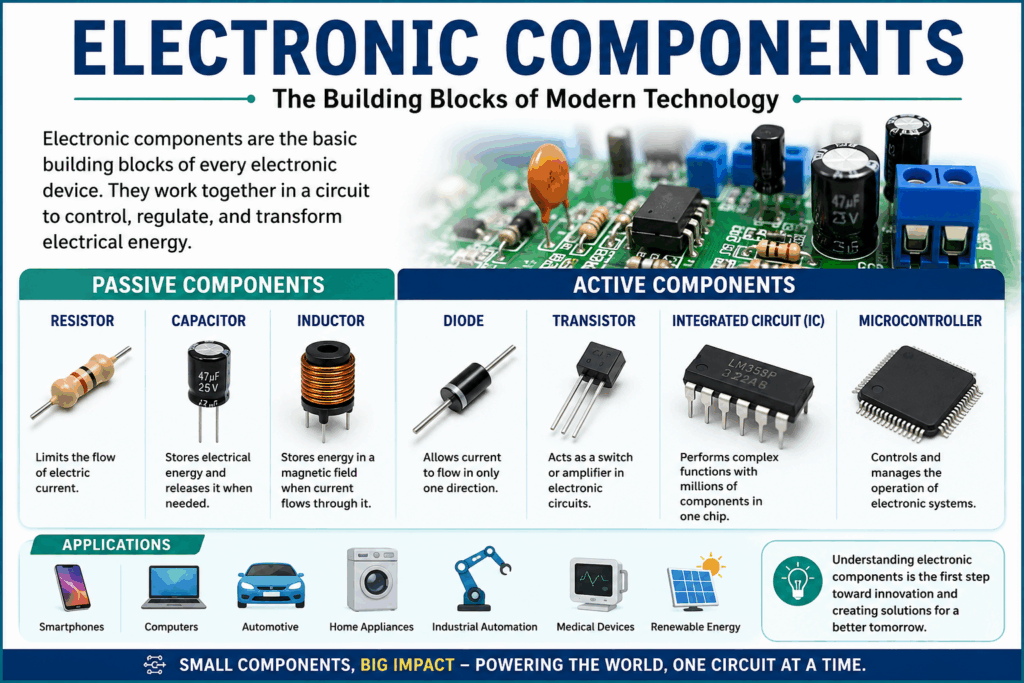
Electronic components are generally classified into two main categories: passive components and active components. Passive components do not require an external power source to operate and include resistors, capacitors, and inductors. Active components, on the other hand, require power and can amplify or control electrical signals. Examples include transistors, integrated circuits (ICs), diodes, and microcontrollers.
Resistors are among the most commonly used electronic components. Their primary function is to limit the flow of electrical current within a circuit. They help protect sensitive components and ensure proper circuit operation. Capacitors store electrical energy temporarily and release it when needed. They are widely used in power supplies, filtering applications, and timing circuits.
Inductors store energy in a magnetic field when current flows through them. They are commonly found in power conversion systems, radio-frequency circuits, and filters. Diodes allow current to flow in only one direction, making them essential for rectification and voltage protection applications. A bridge rectifier, for example, uses four diodes to convert alternating current (AC) into direct current (DC).
Transistors are considered one of the most important inventions in electronics. They act as switches or amplifiers and form the foundation of modern digital circuits. Billions of transistors are integrated into microprocessors and memory chips used in computers and smartphones.
Integrated Circuits (ICs) combine thousands or even millions of electronic components onto a single semiconductor chip. These compact devices perform complex tasks while reducing size, power consumption, and manufacturing costs. Common examples include operational amplifiers, microcontrollers, processors, and memory devices.
Surface Mount Devices (SMDs) have revolutionized electronics manufacturing. SMD components are mounted directly onto the surface of printed circuit boards (PCBs), allowing for smaller, lighter, and more efficient products. Modern consumer electronics rely heavily on SMD technology to achieve compact designs.
Electronic components continue to evolve as technology advances. Innovations in semiconductor manufacturing, nanotechnology, and materials science are enabling faster, more energy-efficient, and highly reliable devices. From renewable energy systems and electric vehicles to artificial intelligence and communication networks, electronic components play a critical role in shaping the future.
Understanding electronic components is essential for engineers, hobbyists, students, and technology enthusiasts. By learning how these components function and interact within circuits, individuals can design, troubleshoot, and innovate electronic systems that power the modern world.
#ElectronicComponents #Electronics #CircuitDesign #PCBDesign #ElectricalEngineering #DIYElectronics #Resistors #Capacitors #Diodes #Transistors #IntegratedCircuits #SMDComponents #Microcontroller #EmbeddedSystems #Technology #Engineering #ElectronicsProjects #CircuitBoard #Innovation #TechEducation